

Wedding Invitation Design
Short answer: At Poua Design, wedding invitation design starts from the couple's story and ends in a handmade, printed object that fits the venue, the colours and the style of the day.

Short answer: At Poua Design, wedding invitation design starts from the couple’s story and ends in a handmade, printed object that fits the venue, the colours and the style of the day. We take care of the concept, illustration, typography, choice of paper and technique (letterpress, foil stamping, digital printing) and every matching piece of stationery: envelope, RSVP card, menu, favour tags. The usual time from the first meeting to delivery is 4–8 weeks.
Why a wedding invitation is more than a card
The invitation is the first thing your guests will hold in their hands. Before they see the venue, the décor or the dress, they’ll form an impression of your wedding from a piece of paper. That’s why we don’t treat it as “a card with a date”, but as the first part of a visual story that continues in the menu, the seating, the favours and every detail of the day.
At Poua Design we believe every couple should have their own, unique invitation. Not a choice from a catalogue, but a design from scratch, inspired by something that matters to you: the place of the ceremony, a colour you love, a flower, a trip, a family detail. The same philosophy we apply to a business’s branding applies here: idea first, form second.
How we work: from the first meeting to delivery
1. Getting to know you, and the concept
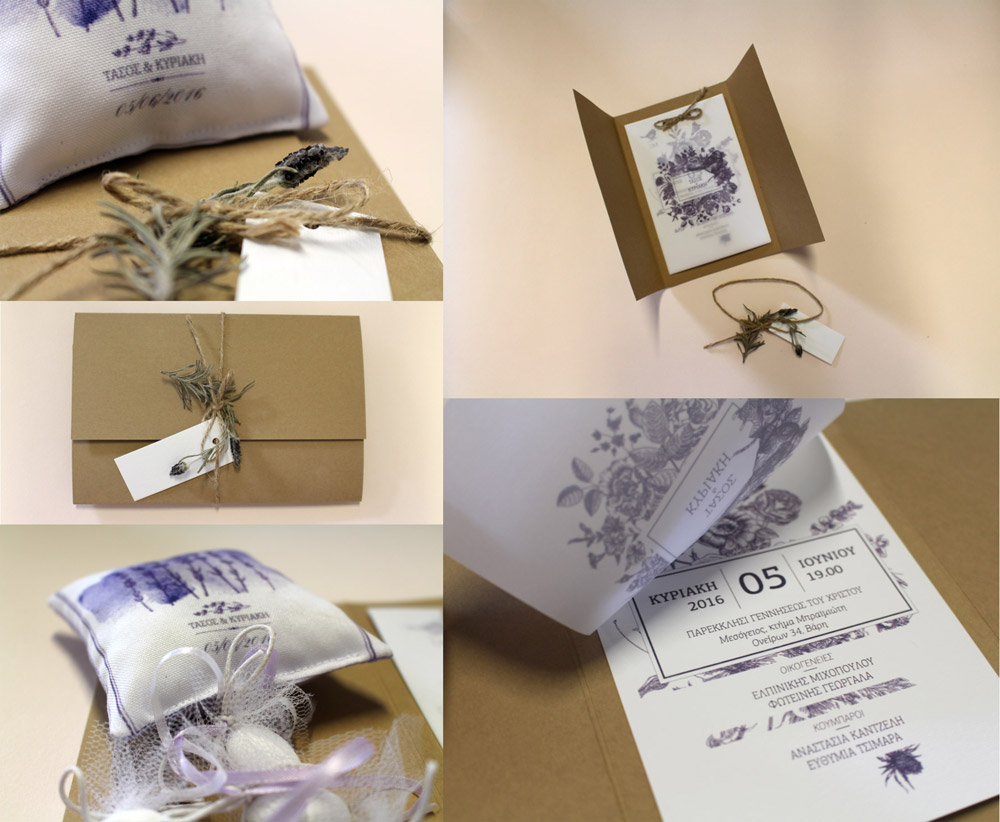
We start with a conversation at the studio or online. We want to know where the wedding is, at what time, how many guests, the style of the venue and, above all, what expresses you as a couple. The central theme comes from there. For Tasos and Kyriaki’s wedding, held on a lush estate with natural décor, we proposed lavender as the central element, and it determined colour, materials and favours.
2. Design and illustration
We present 2–3 directions with typography, colours and artwork. Many of our invitations feature hand-made illustration (pencil, ink or watercolour) that is then digitised, so the result looks like no other. You choose the direction, and we develop it with you through 2 rounds of revisions.
3. Paper, printing technique, finish
This is where the feel of the invitation in the hand is decided. We show you paper and technique samples, calculate the cost per piece and choose the best solution for your budget. More on how we supervise print production.
4. Proof, production, delivery
Before final printing you see a physical proof. We supervise production at the printer and, where needed, take on the handmade finishing: binding, seal, ribbon, dried flower. We deliver ready, counted, with their envelopes.
Printing techniques for invitations: which suits you
Letterpress
The classic technique, pressing relief into thick cotton paper. The letters “sink” into the paper and the result can be felt as well as seen. It suits minimalist, typographic designs in 1–2 colours. It costs more than digital printing, but for weddings of 80–150 invitations the difference is manageable and the result incomparable.
Hot foil stamping
Metallic foil (gold, silver, copper, rose gold or even matte colours) pressed into the paper with heat. It gives shine and a feeling of luxury, ideal for names, monograms or fine decorative elements. It combines superbly with letterpress or with dark papers.
Digital printing
The most economical and flexible option, essential when the design has watercolour, photography or many colours. With the right paper (cotton, embossed or textured) the result can be just as high-quality. We often combine digital printing for the artwork with foil stamping for the names.
Handmade details
What the machine doesn’t do, we do: wax seals, ribbon or twine binding, hand-cut paper, dried flowers, lined envelopes. These details make the difference between a lovely invitation and one guests keep for years.

What a complete invitation set includes
The invitation rarely goes alone. We design the whole “paper family” of the wedding with a shared look, so each piece is recognised as part of the same whole:
- Invitation and envelope (with or without lining, printed return address).
- RSVP card or, increasingly, a small card with a QR code to an online confirmation form.
- Information card: accommodation, transport, dress code, gift list.
- Day-of stationery: menu, ceremony programme, place cards, seating chart, welcome sign.
- Favours and tags: at the lavender wedding, we printed designs inspired by the invitation on fabric, sewed them into small cushions and filled them with lavender seeds.
- A thank-you card after the wedding.
If your wedding is a destination wedding on an island or in the countryside, we also design the welcome materials (welcome bag, map, three-day programme) in the same look. We follow the same system logic when we design branding for hotels and accommodation.
Timing and planning
Ideally we start 4–6 months before the wedding. Design takes 2–4 weeks, production 1–3 weeks depending on the technique (letterpress and foil stamping take longer than digital), and invitations should reach guests 6–8 weeks before the date, or 3 months before if you have guests from abroad. If you have less time, tell us at the start: there are solutions, as long as we choose technique and paper accordingly.
Cost: what it depends on
The price of a wedding invitation depends on four factors: quantity (cost per piece drops significantly above 100), printing technique (digital, letterpress, foil stamping or a combination), paper (weight, composition, imported or not) and handmade finishing. Design is priced separately from production, so you know exactly what you’re paying for. After the first meeting we give you a written quote with 2–3 alternatives at different budget levels.
FAQ: wedding invitation design
How much does wedding invitation design cost?
Design is priced separately from printing. The total cost depends on quantity, technique (digital, letterpress, foil stamping), paper and handmade finishing. After the first meeting we give a written quote with alternatives at different budget levels.
How long does a handmade wedding invitation take?
In total 4–8 weeks: 2–4 weeks of design with revisions and 1–3 weeks of production. Ideally we start 4–6 months before the wedding, so invitations can go out 6–8 weeks before the date.
What’s the difference between letterpress and foil stamping?
Letterpress presses ink deep into thick paper, giving a relief texture you can feel. Foil stamping presses a metallic or coloured foil (gold, silver, rose gold) into the paper with heat, giving shine. They’re often combined on the same invitation.
Can you design the rest of the wedding stationery too?
Yes. We design the whole set with a shared look: envelope, RSVP card, information card, menu, programme, place cards, welcome sign, favour tags and thank-you card.
What’s the minimum quantity of invitations?
There’s no strict minimum, but for letterpress and foil stamping the cost per piece becomes reasonable from around 50 pieces. For digital printing we can produce smaller quantities.
Do you work with couples outside Athens?
Yes. Our studio is in Athens, but much of the collaboration happens online and invitations are shipped across Greece and abroad. We have experience with island weddings and destination weddings.
Let’s design your wedding invitation
If you want an invitation that tells your own story and stands the test of time, get in touch. We’ll discuss the style of your wedding, you’ll see paper and technique samples and receive a quote without commitment. See how we can work together or all Poua Design services.
Founder, graphic designer & creative director of Poua Design. She has been designing identities, packaging and print in Athens for 15+ years.
WHO WE ARE →