

Logos for Associations, Municipalities & Cultural Bodies
Short answer: The logo of an association, municipality or cultural body should capture local identity (architecture, tradition, landscape, history) in a mark that is simple, recognisable and easy to use on stamps, posters, websites and signs.
Short answer: The logo of an association, municipality or cultural body should capture local identity (architecture, tradition, landscape, history) in a mark that is simple, recognisable and easy to use on stamps, posters, websites and signs. Poua Design designs logos for cultural associations, municipalities and bodies across Greece (Kythnos, Anafi, Athens), with research into local heritage, vector design and a full usage guide, in 3–5 weeks.
Why an association or municipality needs a properly designed logo
A cultural association, a municipality or a local body doesn’t sell a product. It represents people, a place and a history. Its mark appears on document stamps, event posters, performance programmes, banners in squares, official websites, social media and volunteers’ t-shirts. When the logo is rough or copied from generic clip art, the body’s image loses seriousness, people don’t recognise it and every poster looks different.
By contrast, a mark designed on local identity works as a shared point of reference: residents recognise it, sponsors and partner bodies respect it, and it stands with dignity beside the logos of Regions, Ministries or European programmes on co-funded print.
What makes a body’s logo different from a commercial logo
It must express a community, not an owner
In a business, the logo answers “who are we and what do we sell?” In an association or municipality, it answers “what unites us?” That’s why research starts from the place: the characteristic building, a local weaving pattern, the natural landscape, a historic symbol or an element of folk tradition. On Kythnos, the Piatsa of Chora, where the swing custom is revived every Easter, is a place every resident recognises at once. On Anafi, the landscape of the Monastery of Kalamiotissa and the rock of Kalamos shaped the whole visual language.
It must last decades, not seasons
Businesses rebrand every 5–10 years. A municipality or a historic association changes its mark rarely, often once in a generation. So the design must avoid passing trends (gradients, very thin lines, trendy typefaces) and rely on archetypes and clean geometry that won’t date.
It must work on cheap and difficult media
A commercial logo will usually be printed on good paper by a professional printer. An association’s logo will go through an ink stamp, a photocopier, screen printing on t-shirts, black-and-white printing on letterhead and a Facebook post at 200 pixels. If it hasn’t been designed for that, it will clog up or disappear.
The logo design process for an association or municipality
1. Local identity research
We gather photographs, old publications, historical information, traditional patterns and symbols of the place. We talk to the board or the municipality’s officers to understand what they want to emphasise: tradition, openness, culture, youth. We also record where the mark will be used (stamp, documents, posters, site, t-shirts, banners) because that sets the technical requirements.
2. Sketches and conceptual directions
We always start with pencil. We sketch dozens of variations around 2–3 central ideas: one more traditional, one more contemporary, one that combines the symbol with typography. For the folk dance club Chorevma, for example, the sketches began from the movement of the body in the circle dance and ended in a mark that “whirls”.

3. Digital design in vector format
The strongest ideas are drawn in Adobe Illustrator as vectors, so they scale from 1 centimetre on a stamp to 5 metres on a banner with no loss. We test the mark in a single-colour version, in reverse (white on a dark background), at very small size and in a black-and-white photocopy. If it doesn’t survive those tests, we simplify it.
4. Presenting to the board, and revisions
We present 2–3 final proposals with the reasoning behind each and with applications (stamp, poster, letterhead), not just the mark on a white background. In associations decisions are taken collectively, so the presentation has to be clear and answer questions before they’re asked. Up to two rounds of revisions follow.
5. Delivery of files and a usage guide
We deliver the logo in AI, EPS, PDF, SVG and PNG (with transparency) in colour, single-colour and reverse versions, with a short usage guide: colours (Pantone, CMYK, RGB, HEX), typefaces, minimum size, clear space around the mark and what not to do. That way, whoever takes over the association’s print or social media next year has clear rules.
Examples from real projects
Cultural Association of Chora, Kythnos
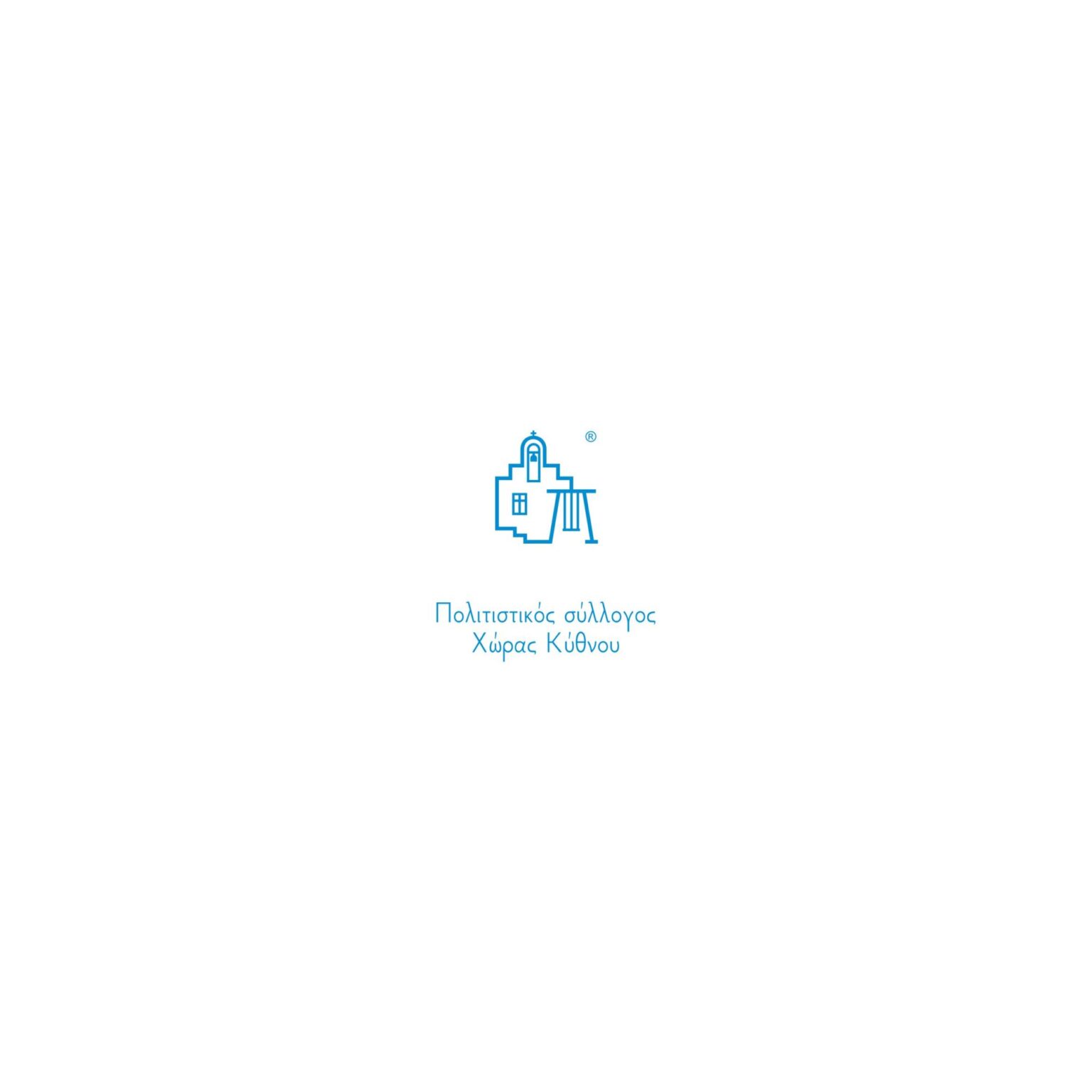
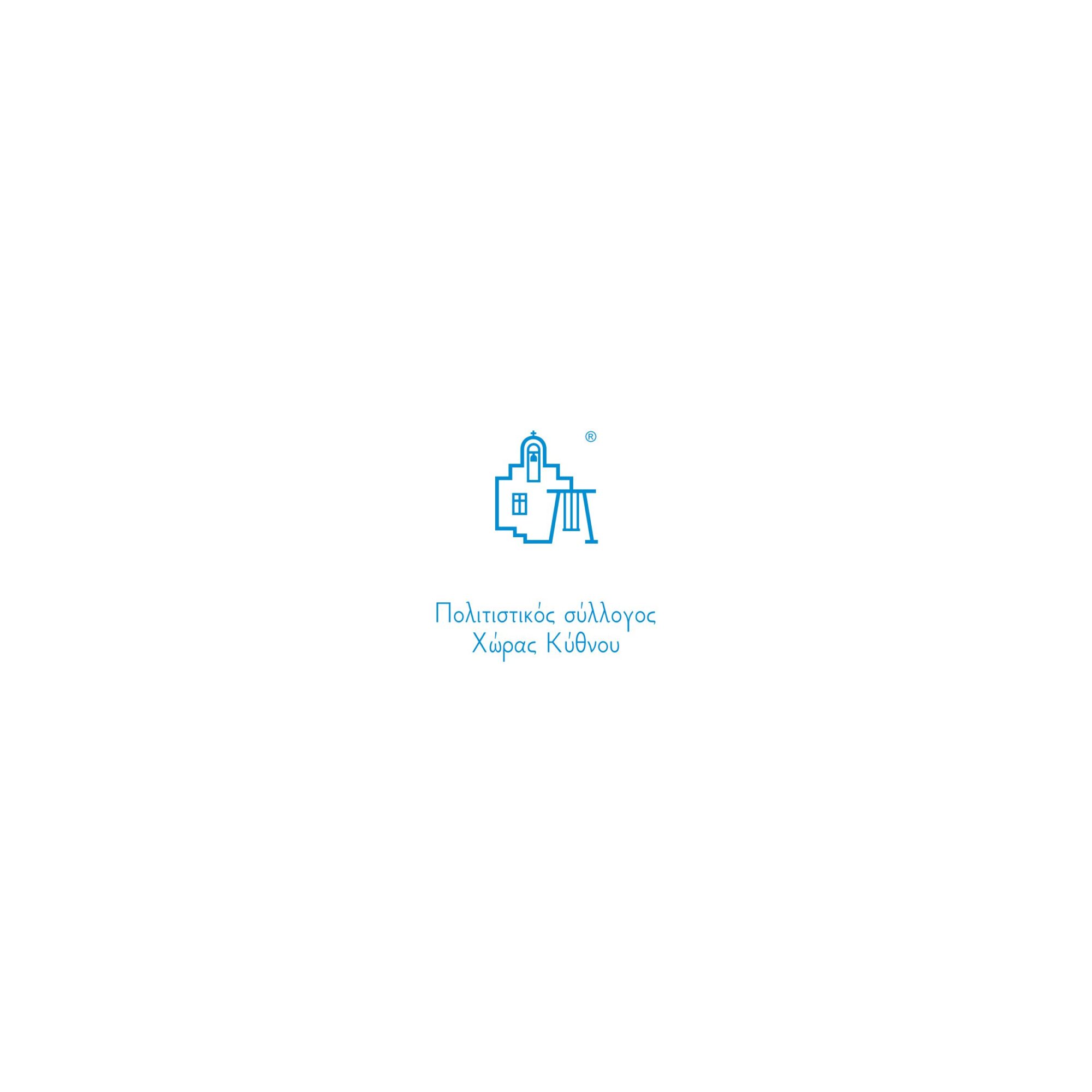
The association wanted a mark that would “speak” to the people of Kythnos at once. We chose the Piatsa of Chora, the village’s best-known gathering place, where the swing custom is revived every Easter, and rendered it in clean lines in a blue reminiscent of the Cyclades. The typography is thin and discreet so the symbol takes the lead. The mark works as a single-colour stamp, on festival posters and in a Facebook post.
Municipality of Anafi
For the Municipality of Anafi we designed the official website, aiming to inform citizens and showcase local history. The visual language was based on the colours of the island and on photographs of the Monastery of Kalamiotissa and Chora, so the site is a natural continuation of the place’s identity. More on website design in the related article.

The folk dance club Chorevma and Cultural Travellers
Two cultural associations in Athens with years of collaboration. For Chorevma, the logo drew on the movement of the dance and was applied to cards, letterheads, members’ t-shirts and performance posters. For Cultural Travellers we design posters, programmes and event print every year, always with the same mark as the fixed point of reference. See how a mark grows into a complete corporate identity.

What an association or municipality should watch for before commissioning a logo
Legal and institutional issues
Municipalities often have an official emblem (a national coat of arms or historic symbol) that doesn’t change. The new logo is designed to coexist with it, not replace it. For associations, we check that the mark doesn’t clash with already registered trademarks and advise on registering it with the OBI (the Hellenic Industrial Property Organisation) if the association wants to protect it.
Use in co-funded programmes
If the body takes part in ESPA, LEADER or other EU programmes, its logo will appear beside funders’ logos under specific size and spacing rules. We design it to stand equally in that line-up, with a clean horizontal and vertical lockup.
Who will manage it afterwards
Boards change. The usage guide and the right files are what keep the mark consistent in future years, whoever prints the festival poster. For correct print production we can also take on print supervision.
Cost and timing
Logo design for an association or municipality usually takes 3–5 weeks, depending on how quickly the body makes decisions. Cost depends on scope: logo only, logo with basic stationery (stamp, letterhead, cards), or a full identity system with posters, banners, website and social media. For non-profit associations with a limited budget we always suggest a phased approach: first a proper mark with files and guide, and applications gradually. More on the general process in the article on logo design.
Frequently asked questions
How much does a logo cost for an association or municipality?
It depends on the scope of the commission: mark only, mark with basic stationery, or a full identity system. For non-profit associations we suggest a phased approach so cost is spread over stages. Ask for a quote with your specific needs.
How long does the design take?
Usually 3–5 weeks from research to delivery of final files. Time is affected mostly by how fast the board or municipality approves proposals.
Can the new logo coexist with the municipality’s official emblem?
Yes. The official emblem remains for institutional use (documents, stamps) and the new logo is designed for communication, events, tourism promotion and digital media, with clear rules on when each is used.
In what format are files delivered?
Vector (AI, EPS, PDF, SVG) and PNG with transparency, in colour, single-colour and reverse versions, with a usage guide covering Pantone/CMYK/RGB colours, typefaces and minimum sizes.
Do you also design posters and print for the association’s events?
Yes. After the logo we take on posters, programmes, invitations, banners, t-shirts and social media, as well as print supervision, so everything is consistent with the mark.
Do you work with associations outside Athens?
Yes. We’ve worked with bodies on Kythnos, Anafi and other islands and provincial towns. The collaboration happens remotely with video calls and online presentations, with no visits required.
Start your association’s or municipality’s logo
Send us a few words about your body, your place and where the mark will be used, and we’ll reply with a proposal and a timeline. Contact us or see all Poua Design services.
Founder, graphic designer & creative director of Poua Design. She has been designing identities, packaging and print in Athens for 15+ years.
WHO WE ARE →